How to Answer IGCSE French Oral Exam Questions
How to Answer an IGCSE French Oral Exam Question
(With Tips and Examples) — The examiner isn’t expecting perfection. They want to hear how confidently you speak and communicate your ideas.
🔗 Quick Navigation – Jump to Section
🗣️ Communication Over Perfection
The IGCSE French oral exam is designed to test how well you can communicate in spoken French. The examiner is not expecting perfect grammar or advanced vocabulary.
Instead, they want to hear:
- How confidently you speak
- How well you develop your answers
- How effectively you express ideas and opinions on familiar topics
📚 What Will the Questions Be About?
In the IGCSE French oral exam, all questions are based on everyday topics that are familiar to you. You are never asked about abstract or specialist subjects. Typical topics include:
- 👨👩👧👦 Family and friends
- ⚽ Free time and hobbies
- 🥐 Food and daily routines
- 🏠 Home and town
- ✈️ Holidays and travel
- 🏫 School life
- 💼 Future plans and jobs
- 📱 Social media and technology
1️⃣ Understand the Question First
Before answering, take a moment to understand the question. Listen carefully and identify:
- The topic
- The key verb (e.g., aimer, faire, préférer, penser…)
- The time frame (past, present, or future)
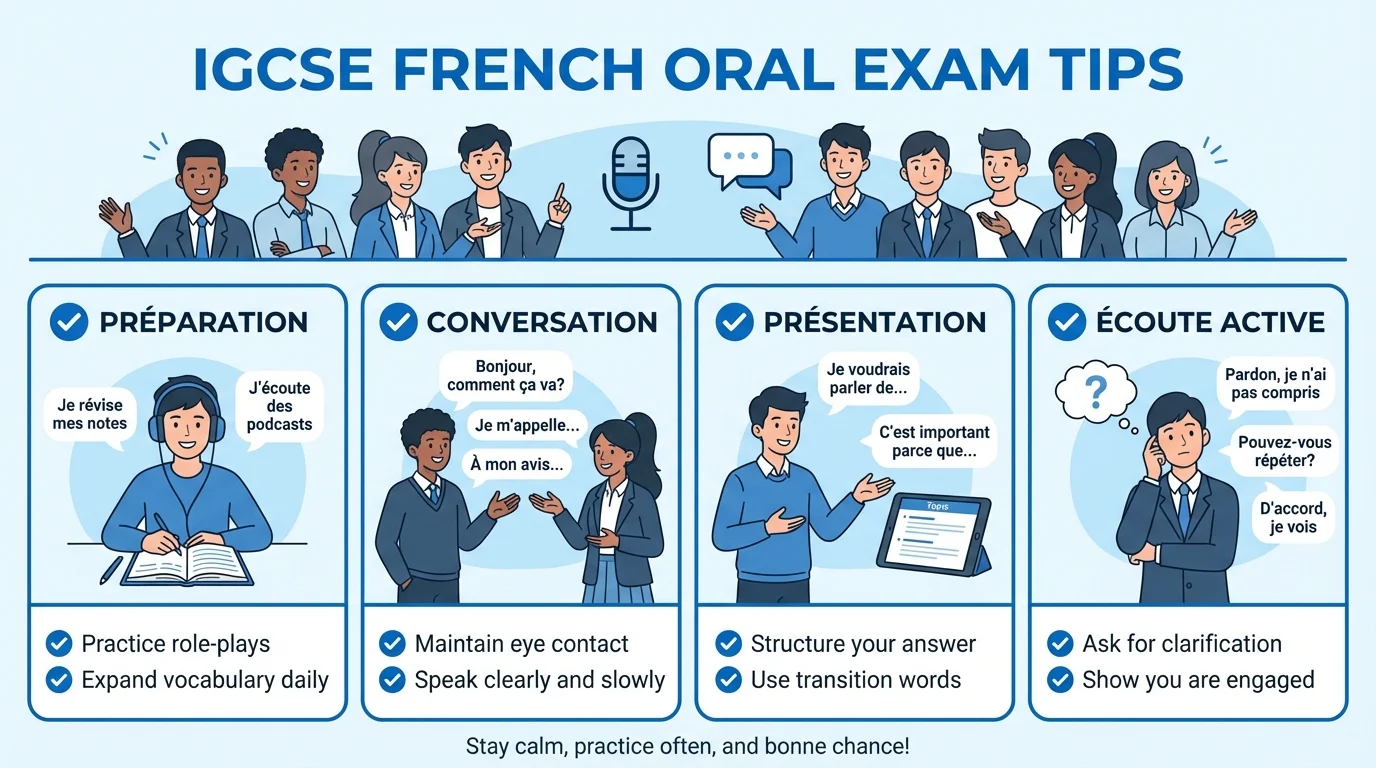
💡 Pro Tip: If you are unsure, you are allowed to ask the examiner to repeat the question:
« Pardon, pouvez-vous répéter, s’il vous plaît ? »
This is completely acceptable and does not reduce your marks. It is better to clarify than to answer incorrectly.
2️⃣ Do Not Answer Only “Yes” or “No”
🚫 Common Mistake: Stopping after one sentence.
One of the most common mistakes in the oral exam is stopping after a short answer such as oui or non.
Always ask yourself: “Can I add another detail?”
The examiner wants to hear how you manage spoken French: how you link ideas, give explanations, and keep talking.
✅ 6 Elements to Make Your Answer Complete
Use this mental checklist every time you answer a question:
Explain your opinion or choice.
“J’aime l’école parce que j’apprends des choses utiles pour l’avenir.”
(I like school because I learn useful things for the future.)
Include information about time, place, frequency, or people.
“J’y vais du lundi au vendredi et je travaille surtout le matin.”
(I go there from Monday to Friday and I mainly work in the morning.)
Examples make your answer clearer and more natural.
“Par exemple, j’aime le français et l’histoire.”
(For example, I like French and history.)
Show personal thinking using opinion phrases.
“À mon avis, l’école est importante parce qu’elle prépare les jeunes au monde du travail.”
(In my opinion, school is important because it prepares young people for work.)
Using different tenses shows a stronger level of French.
“L’année dernière, j’ai changé d’école et à l’avenir je voudrais aller à l’université.”
(Last year, I changed schools and in the future I would like to go to university.)
A small contrast makes your answer sound more advanced.
“Cependant, je trouve que les devoirs sont parfois stressants.”
(However, I find homework sometimes stressful.)
🌟 Example of a Complete Answer
Question: Aimes-tu les réseaux sociaux ?
“Oui, j’aime beaucoup les réseaux sociaux parce que je peux rester en contact avec mes amis. J’utilise surtout Instagram et WhatsApp tous les jours. Par exemple, j’envoie des messages et je regarde des photos. À mon avis, c’est très pratique pour communiquer, mais parfois c’est une perte de temps. À l’avenir, j’essaierai de passer moins de temps sur mon téléphone.”
Why is this answer great? It includes opinions, reasons, details, examples, different tenses (present & future), and a contrast — exactly what examiners are looking for! 🏆
🧘 Last Minute Advice: Stay Calm
It is better to pause briefly and give a clear, developed answer than to rush and panic.
- Small mistakes are normal. don’t worry!
- Take your time to think.
- What matters most is that you keep speaking and communicate your ideas clearly.
Ready to Ace Your IGCSE French Oral Exam?
Get expert preparation with our native teachers. We focus on confidence, fluency, and exam techniques.
✅ IGCSE-focused workshops | ✅ Mock oral exams | ✅ Native French teachers
🔗 External Resources & Official Links
📋 Official Exam Bodies
-
HKEAA (Hong Kong Examinations and Assessment Authority)
www.hkeaa.edu.hk -
Cambridge International
www.cambridgeinternational.org -
Pearson Edexcel
qualifications.pearson.com
📚 Interactive French Resources
-
IGCSE French Courses (Ages 14-16)
View Teen Courses -
Free Consultation
Book Your Free Assessment -
All Courses
Browse All French Courses

Sarah Marchand
French language educator and content creator at Interactive French.
Related Posts
Complete Guide to French Pronouns: Types, Usage & Examples
What Are Pronouns? Subject Pronouns Object Pronouns Other Pronoun Types Common Mistakes 📚 The Complete…
Read More
IGCSE French Exam: 8 Strategic Steps to Success
Exam Structure Study Plan Core Skills Exam Techniques Health & Wellbeing A Comprehensive Strategy Guide…
Read More
What is the AP French Exam?
Are you passionate about the French language and aiming for academic excellence? The AP French Language and Culture exam…
Read More