How Long Does It Take to Become Fluent in French? An Honest DELF Timeline
The question every future francophone asks
It is usually the first question, asked right after « Bonjour »: “How long before I can actually speak French?” French has a tough reputation — the spelling, the grammar, the nouns that are mysteriously masculine or feminine, the verbs that seem to follow no rule at all. So let’s be honest from the start: French is not harder than any other major language, but it does demand something most people underestimate — consistency and real motivation. Talent is optional; showing up is not.
The good news? Fluency is not a lottery. Linguists measure it, diplomas certify it, and language schools like ours plan for it every day. It is a timeline you can understand — and once you understand it, you can shorten it.
A world language — on the rise
Before counting the hours, remember what the effort buys you. French is now the 4th most spoken language in the world, with nearly 400 million speakers across five continents (Ministry for Europe and Foreign Affairs, 2026), and demographic projections suggest it could become the 3rd most spoken language by 2050. It is also a working language of international institutions — the United Nations, the European Union, the Olympic Games — and of business across Europe, Africa and Canada.
Learning French is not a school subject — it is a passport to an enormous world of people, careers and ideas. And there is a deeper reward: learning French helps you understand the culture and its codes. Every language carries its own way of seeing the world — the rituals of la politesse, the art of conversation, the humour, the references everyone shares. Speak the language and the culture stops being a stereotype and starts making sense from the inside. You don’t just order the meal; you understand why the meal matters.
What does “fluent” even mean? Let the DELF be your map
“Fluent” is vague; the DELF (Diplôme d’études en langue française) is precise. It is the official, internationally recognised French diploma, and its levels give you a measurable road to travel:
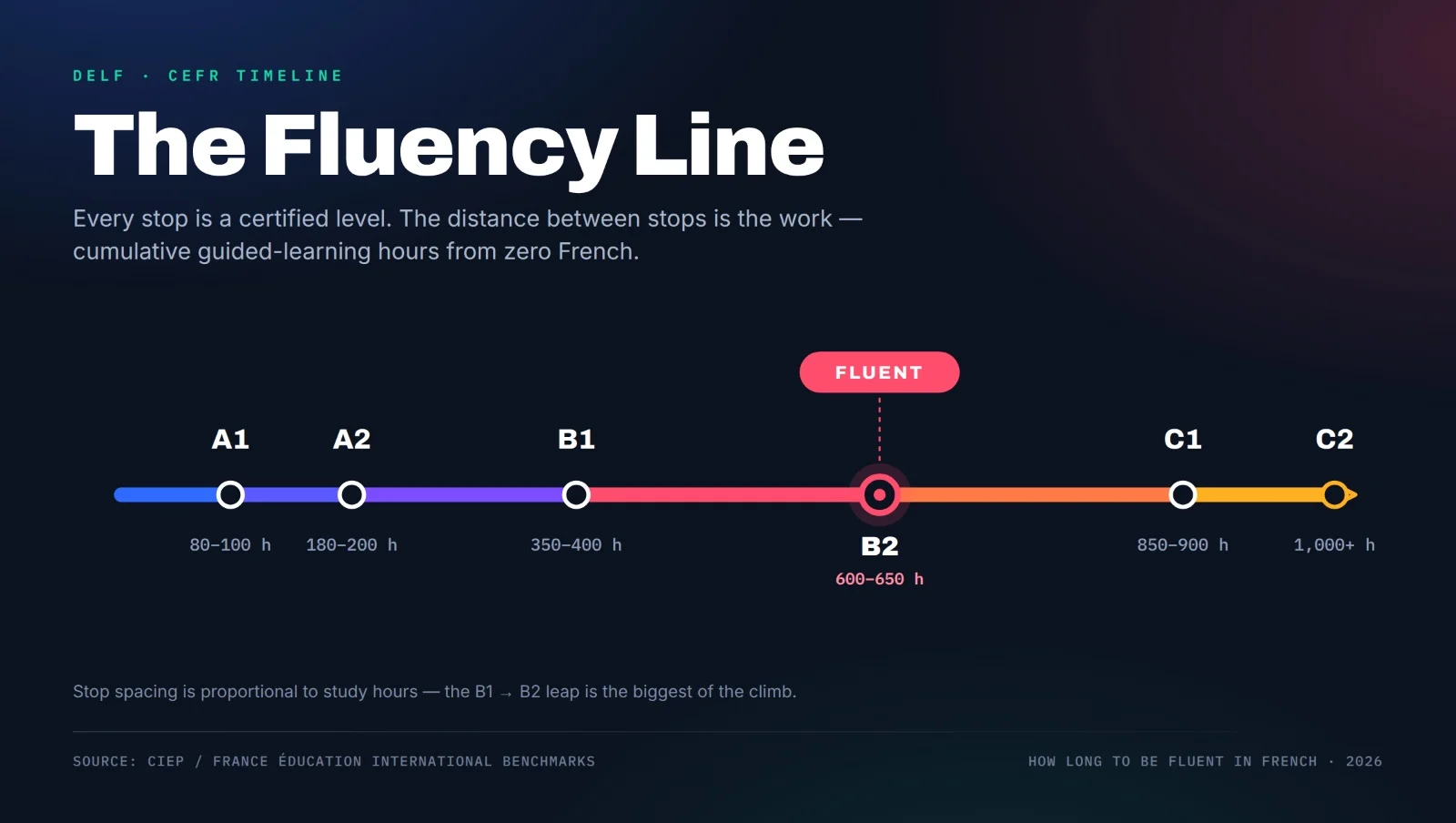
*Cumulative guided-learning hours commonly used by French-language schools; they assume regular personal work on top. For English speakers, French is even classified among the easiest major languages to learn — roughly 600–750 hours to professional working fluency.
The key threshold: for most people, “fluent” means B2 — you follow conversations, argue, joke and work in French. Six hundred-odd hours sounds far away. With the right routine, it is not.
Exam milestones for students in Hong Kong
If you are a parent or a student, the roadmap above maps directly onto the exams that matter here in Hong Kong. Each school exam is a milestone on the same road — none of them is a separate journey:
The alignment varies slightly from one exam board and one syllabus to another, but the logic is constant: each exam certifies a stage of fluency. That is why preparing for DELF exams is such a powerful strategy for school students — the diploma you take at 15 is the same your university or employer will recognise later. You are not collecting certificates; you are climbing one well-marked ladder.
The real accelerator: the 50% rule
Here is what separates the students who make it from the ones who stall at A2: learning French has to be a real motivation, because half of the time spent should be in self-study. Lessons with a teacher are your engine — structure, corrections, someone to talk to. But lessons alone will not make you fluent; what you do between lessons is what makes the language stick.
Think of it this way: one hour of class plus one hour of your own time beats two hours of class, every single week. Concretely, a student with two one-hour lessons a week should add roughly another two hours of personal work — and with our daily trick below, that fits into moments you already have. Self-study is where vocabulary gets revised, listening gets trained and confidence gets built. Skip it, and every lesson starts from zero; do it, and every lesson starts one step higher.
Your best friend: 10–15 minutes a day — of something you love
Practice daily for 10 to 15 minutes — that’s it. Ten minutes every day beats two hours every Sunday, because your brain needs frequent contact with the language, not heroic sessions. And make those minutes pleasurable: link your learning to something you already like — music, podcasts, films, series, articles, books — anything where you find joy.
- Put your phone in French — you will learn forty words a week without noticing.
- Build a playlist of French songs and learn the lyrics by heart.
- Watch a series you already love, dubbed or subtitled in French.
- Read articles, or revisit a favourite book — the story is already yours.
- Follow French accounts about your hobbies: cooking, football, photography, whatever you love.
If it is enjoyable, it is sustainable — and sustainability is what creates fluency. Nobody ever reached B2 on willpower alone; people reach it because their French hour became the best hour of their day.
It is not just grammar and exercises
A language is not a list of conjugations. Learning French is also fun and practice with local people — real conversations, real mistakes, real laughter. Join a language exchange, chat with classmates after class, order in French at the restaurant, talk to yourself while cooking, greet your neighbours with a cheerful « Bonjour ! ».
Mistakes are not the enemy of fluency; silence is. Every learner who speaks “beautifully” on day thirty is the one who spoke badly on day one — out loud. Grammar gives you the scaffolding; humans teach you to speak.
The immersion boost: step out of your comfort zone
If you want to compress years into months, nothing works like immersion. A trip to a French-speaking country — pushing yourself outside of your comfort zone — can be a massive boost in your learning adventure. When the baker answers only in French and the pharmacy label has no English subtitle, your brain stops translating and starts thinking. Even better: stay a month in an intensive program. A few weeks of full-time French, where every bakery stop and every bus ride becomes a lesson, is worth more than a year of hesitant weekly study.
And it does not have to wait for a gap year. An intensive summer month at 15 can carry a student through two school years of French; an adult between jobs can return with a level that normally takes a year of evenings.
Paris is nice — but France is not just Paris
Here is the secret most course brochures won’t tell you: Paris is nice, but other cities will give you a far better understanding of the culture. In Lyon, Bordeaux, Nantes, Toulouse, La Rochelle or Montpellier, daily life unfolds in French — people have time to talk to you, immersion is real, and every interaction becomes practice. You will live the culture more than you visit it, usually at a gentler cost: the student in Montpellier speaks French at the market because, quite simply, there is no other option — and that is exactly the point.
The same goes for the wider Francophonie: Québec, Belgium, Switzerland, Senegal… each is a different doorway into the language, each with its own accent, food and rhythm. Wherever you go, leave the tourist bubble: take the small town over the resort, the family homestay over the hotel, the market over the mall. Your comfort zone is the only border that still matters.
So, how long will you take?
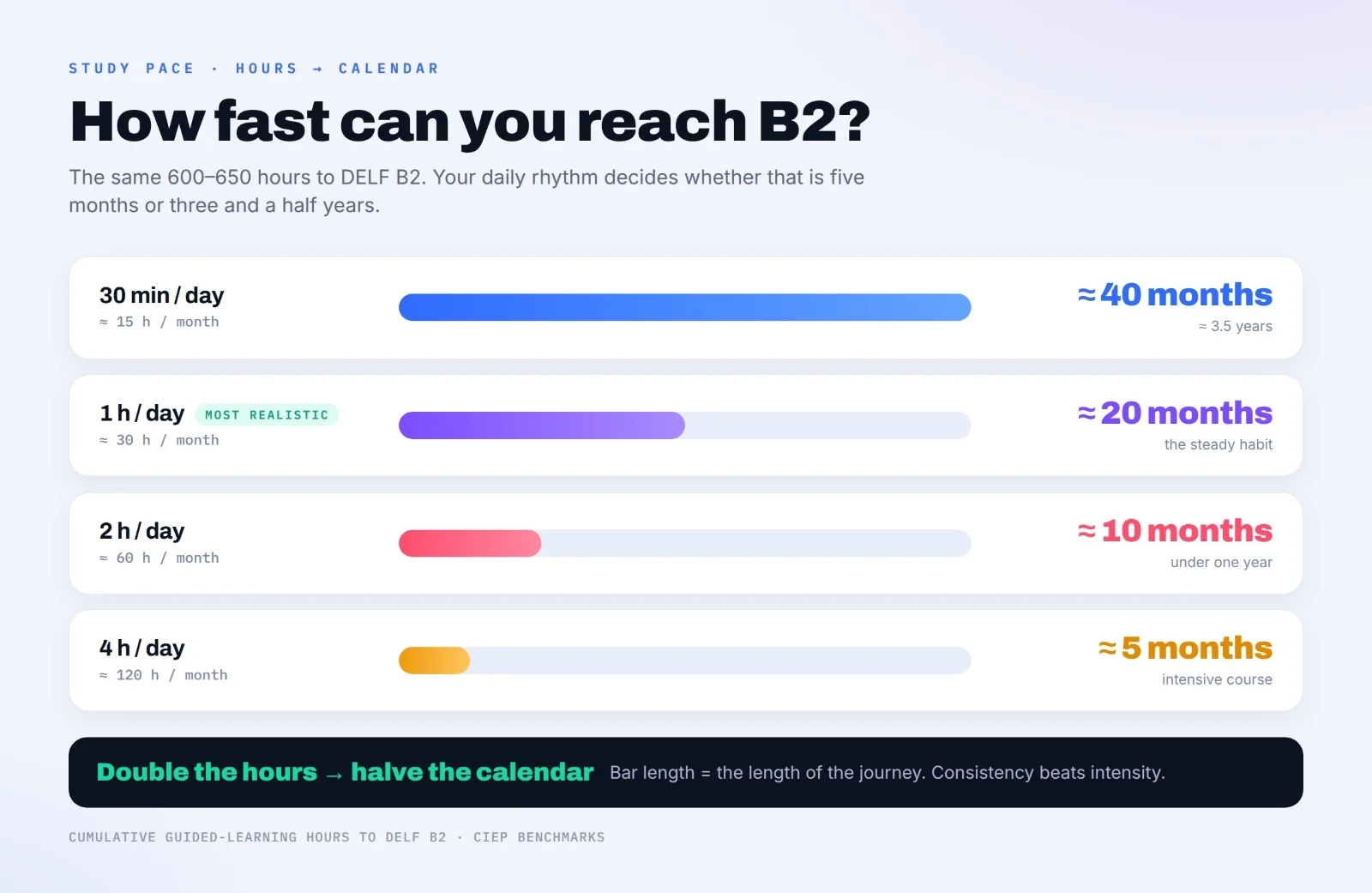
For a motivated learner taking regular lessons and adding daily self-study, a realistic roadmap looks like this:
- About a school year (~180–200 hours) → A2: the HKDSE zone — holiday French, everyday exchanges.
- 1 to 1.5 years (~350–400 hours) → B1: the IGCSE zone — independent, you hold your own.
- 18 months to 2.5 years (~600–650 hours) → B2: fluent and spontaneous — exams, work, life in French.
- An immersion month? Expect to shave months off those estimates.
French is not hard — it is honest: it gives back exactly the time and joy you put in. Start today, ten minutes, one song at a time.
Frequently asked questions
Is French really harder than other languages?
No. For English speakers it is one of the easiest major languages — same alphabet, thousands of shared words, and about 600–750 hours to working fluency. It simply demands more daily consistency than a weekend hobby.
Can I become fluent in 6 months?
You can reach a solid survival level (A1–A2) in six months with daily practice, and more with full immersion. True B2 fluency in six months is unrealistic for most — 18 months to 2.5 years is the honest range.
How long before DELF A2 — the HKDSE level?
Around 180–200 guided hours, typically one school year of steady study. Add the daily 10–15 minute habit and a motivated student arrives early.
Do I have to live in France to become fluent?
No. An immersion month is a fantastic accelerator, but the 50% self-study rule, a daily routine and regular practice with locals can take you all the way to B2 from home.
Am I too old to learn French?
Never. Adults often learn faster than children — better study habits, clearer goals, real motivation. Consistency matters far more than age.
Group lessons or private tuition?
Both work. What matters is the amount of speaking time and the self-study you do between sessions — that is why our DELF, IGCSE and IB students get a personal plan, not just a timetable.

Anthony Regent
✍️ Anthony: Expert French Educator & Blog Author Anthony is a highly experienced French educator and prolific article writer, dedicated to making French accessible and engaging for everyone. With over 10 years of experience in the field, he brings deep educational insight to his content. His extensive background includes working as a course coordinator and innovator in curriculum design, where he expertly developed French syllabi and created effective lesson materials. This expertise informs every blog post he writes. As a valued blog author, Anthony specializes in writing insightful, authoritative articles about: - French Learning Tips and effective study strategies. - In-depth breakdowns of French Exams (DELF, DALF, TCF preparation). - Fascinating insights into French Culture and Francophone life. Follow Anthony's blog for expert guidance, practical tips, and a deeper understanding of the French language and culture. Learn, master, and read with a decade of expertise!
Related Posts

Why is French Gendered? Origins and Explanations
Origins of French GenderPurpose of Grammatical GenderGender in PracticeThe Gender Debate 🇫🇷 The Origins of…
Read More
15 Effective Ways to Practice French Outside the Classroom
Why Practice Matters Effective Methods Balanced Routine Making French Daily Learning French requires consistent practice,…
Read More
DELF A1 Exam Preparation Hong Kong — Your Guide to Success
Master the DELF A1 exam in Hong Kong with Interactive French. Our expert tutors provide…
Read More