
Summer French Learning: Your Ultimate Passport to Global Future

Summer in Hong Kong is an open window — and at Interactive French, we’ve helped over 10,000 students use that window to unlock a new language. Whether your child has never said a word of French or your teenager is gearing up for IGCSE exams, summer is the most powerful time to make progress. Here’s why.

☀️ Early Bird Discount — Limited Spots

Our 2026 Summer French Courses fill up fast. Grab your early bird discount before 15 June — maximum 6 students per class guaranteed.

Why Summer Is the Best Time to Learn French

The research is clear: short, intensive programmes outperform longer, scattered courses. Without the distractions of the school year, students absorb more — and retain it. This is especially important for children and teenagers, where “summer slide” (the regression in skills during the holidays) is a real risk.

  • No academic pressure — students learn French without the stress of grades or homework from other subjects
  • Daily immersion — concentrated sessions mean skills compound week on week
  • Exam momentum — perfect timing to get ahead for September IGCSE, DELF, or IB sittings
  • Confidence before the school year — students return in September with a head start

As one of our tutors puts it: “French is not just a classroom subject — it’s spoken across five continents. A summer spent with us opens doors to careers, travel, and universities that simply aren’t available in English alone.”

Student writing French vocabulary in a notebook during a language lesson at Interactive French Hong Kong
Every summer class is structured around real progress — not just keeping students busy

Our Summer Courses — What’s Available

Our summer French programmes are intensive workshops — short, goal-oriented, and designed to deliver visible progress in a few weeks. All courses are held in-person at our Wan Chai centre; teen courses are also available online.

👧

Summer French for Kids

Ages 6–11 · A0 → A2 · Games, songs, stories, and activities that make French genuinely fun. Max 6 kids per class.

🎓

Summer French for Teenagers

Ages 12–18 · Includes IGCSE, IB, and DELF preparation. Native tutors, small groups, exam-focused methodology.

💼

Summer French for Adults

Conversation, travel French, or DELF/DALF preparation. Flexible scheduling around work commitments.

Not sure which course is right? Take our free French level test and we’ll match you to the right programme and starting point.

What Makes Our Summer Courses Different

Every summer course at Interactive French is built on three non-negotiables:

Max 6
Students per class
100%
DELF Pass Rate
Since 2011
In Hong Kong
  • Native-speaker tutors only — authentic French from day one, not textbook pronunciation
  • Maximum 6 students — everyone speaks in every class, no passengers
  • Culture woven in — French through real-life scenarios, not grammar drills; students internalise the language
  • Exam-proven methodology — the same 30/30/30 structure behind our 100% DELF pass rate
  • Wan Chai centre + online option — convenient location, flexible format for busy families

Summer French for Every Age Group

Children (Ages 6–11)

For young learners, summer French at Interactive French is built around games, songs, stories, and movement. Our French for Kids programme runs through summer with the same small-group format — maximum 6 children — so every child gets to speak and participate. Many kids who start with us in summer discover a genuine love for the language that carries through to secondary school.

Teenagers (Ages 12–18)

For teenagers, summer is prime time for exam preparation. Our French for Teenagers summer courses cover IGCSE, IB, and DELF preparation with native tutors who understand exactly what examiners are looking for. Students who join us in summer consistently arrive in September with a measurable advantage over their peers.

Adults

For adults, summer flexibility makes it easier to fit intensive French into a busy schedule. Whether you’re preparing for DELF/DALF certification, planning an extended trip to France, or simply want to reach the next level, our adult French courses run year-round with summer-friendly scheduling options.

Limited spots — Summer 2026 is filling up

Book a trial class and get a personalised summer plan. Not satisfied? Full refund guaranteed.

Frequently Asked Questions

What makes Interactive French’s summer programmes special?

Three things: native-speaker tutors, classes capped at 6 students, and a methodology that has produced a 100% DELF pass rate since 2011. We don’t run large holiday camps — every summer class is the same quality as our year-round programme, just concentrated into a shorter window.

Are summer courses suitable for complete beginners?

Yes. We run courses from A0 (absolute beginner) to C2 (mastery). Take our free level test and we’ll place you in the right group from day one. Summer is an excellent time to start — no prior French needed.

How do summer courses help with DELF or IGCSE exams?

Intensive summer preparation compresses months of progress into weeks. Students who spend 4–6 weeks with us over summer consistently arrive at their autumn exam sitting more confident and better prepared than those who only prepare during term time. Our DELF/DALF and IGCSE preparation courses are specifically structured around exam content and exam psychology.

What age groups do you cater to?

All ages — from young children aged 6 through to working adults. See our full range: Kids (6–11), Teenagers (12–18), and Adults. Each programme is tailored to the specific learning style and goals of that age group.

DELF A1 Exam Preparation Hong Kong — Your Guide to Success

Personalized DELF A1 French lessons in Hong Kong at Interactive French
Expert DELF A1 preparation at Interactive French — Wan Chai, Hong Kong

Starting your French journey in Hong Kong? The DELF A1 certification is your official first step — and with the right preparation, it’s achievable for anyone. At Interactive French, we’ve helped over 10,000 students pass their DELF exams since 2011, with a 100% pass rate. Here’s everything you need to know to succeed.

📋 What is the DELF A1?

The DELF (Diplôme d’Études en Langue Française) is an official diploma from the French Ministry of Education. A1 is the first level — it certifies basic French ability across listening, reading, writing, and speaking. Valid for life. Recognised in 200+ countries.

Why DELF A1 Is Harder Than You Think

The DELF A1 tests four skills: listening, reading, writing, and speaking. While it’s the entry level, Hong Kong students consistently struggle — not because of vocabulary, but because the exam demands spontaneous communication, not memorised answers.

Common challenges we see every year:

  • Freezing during the listening section when an unfamiliar word appears
  • Trying to mentally translate every sentence instead of catching keywords
  • Feeling unprepared for the speaking format (role-play, Q&A with an examiner)
  • Exam nerves — especially for students used to Hong Kong-style written testing
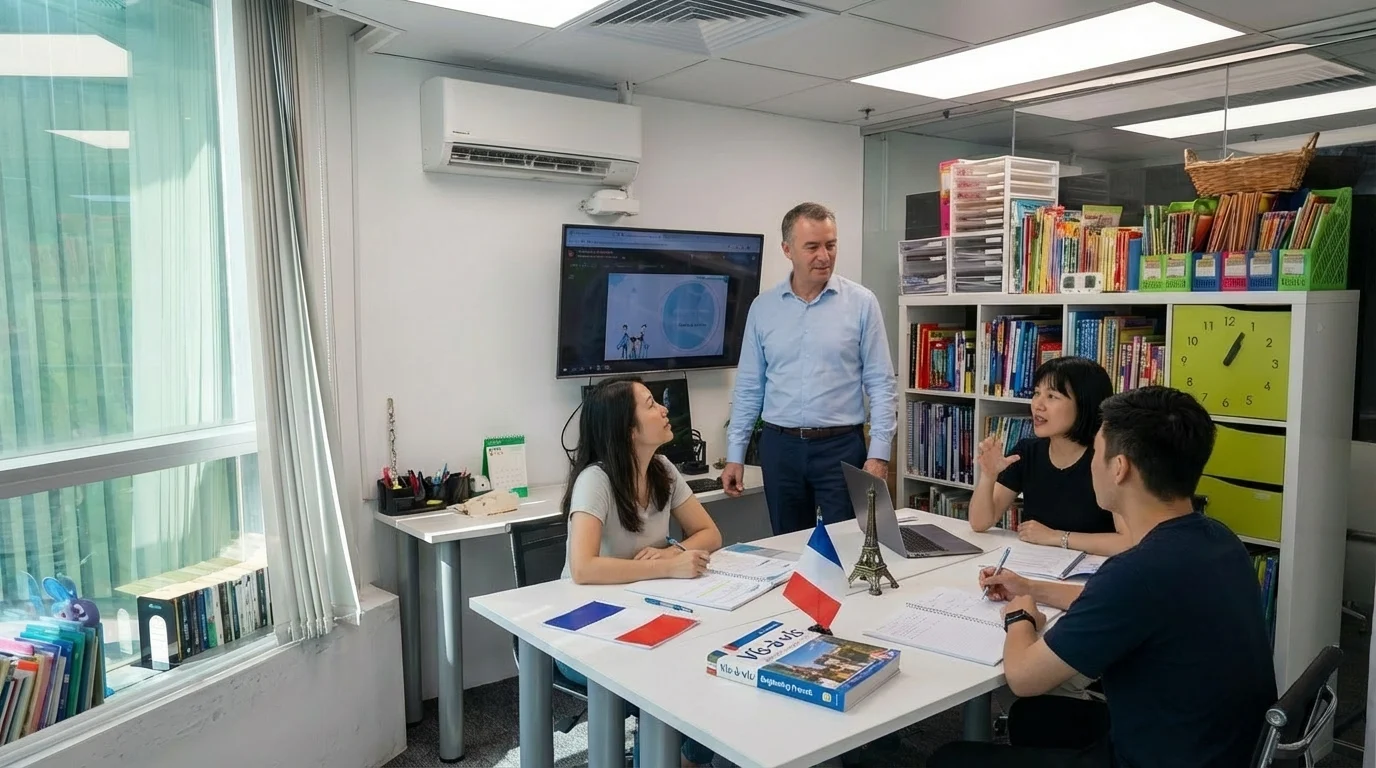
Small group DELF A1 preparation class at Interactive French Hong Kong
Small group classes — maximum 6 students — at our Wan Chai centre

Our Method: The 30/30/30 Session Structure

Every DELF A1 preparation session at Interactive French is built on our proven 30/30/30 framework:

  • First 30 minutes — Grammar and vocabulary essentials targeted directly to A1 exam content
  • Second 30 minutes — Interactive games and exercises that build “muscle memory” for reading and writing tasks
  • Last 30 minutes — Full exam simulation under real conditions: recording speed, strict timing, speaking format

This structure means students are never just “studying” — they’re doing exactly what they’ll do on exam day, week after week. By the time they sit the real DELF A1, nothing feels unfamiliar.

✅ Strategic Listening — Our Key Differentiator

We train students to filter out “noise” and identify keywords: dates, prices, times, proper nouns. We also explicitly teach “distractors” — the misleading details DELF examiners deliberately include (e.g. three prices mentioned, only one is correct). Students who know this never get caught out.

Bringing Paris to Hong Kong

Our native-speaker tutors don’t use generic course materials. Every lesson is grounded in contexts familiar to Hong Kong students — while keeping the French authentic and exam-relevant.

  • Using the MTR map to teach directions in French — familiar geography, real French vocabulary
  • Role-playing ordering at a boulangerie, with curveballs like “sorry, the croissant is sold out” to force fast thinking in French
  • The 3D Information Map technique for the speaking section: students use physical objects to anchor key phrases spatially, eliminating hesitation mid-sentence
  • Question Roulette with icon cards to make demander et donner des informations feel like a game — shifting focus from nerves to interaction
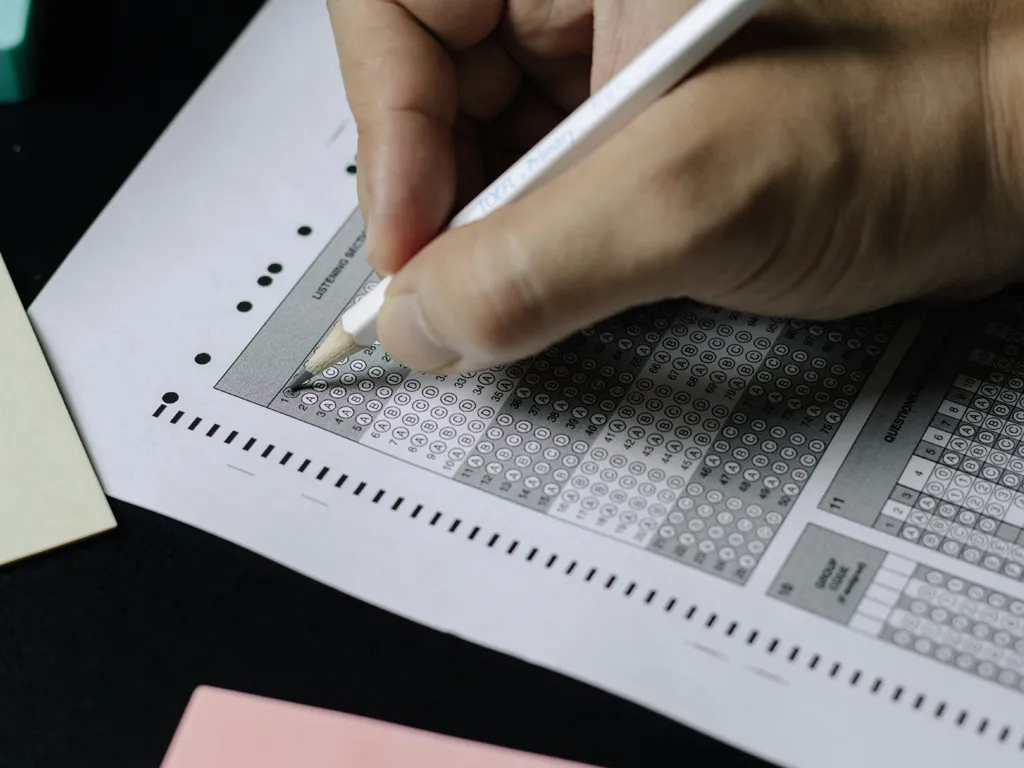
DELF exam past papers used in Interactive French preparation classes Hong Kong
We use real DELF past papers alongside our own materials — students always know the exact exam format

Our Track Record

100%
DELF Pass Rate
10,000+
Students Passed
Since 2011
In Hong Kong

Interactive French has been a cornerstone of French education in Hong Kong since 2011. Our classes stay small — maximum 6 students — so every student speaks in every session. There’s no hiding in a DELF A1 class at Interactive French.

Most students reach A1 readiness within a single term — often within 60 hours of study. This is a direct result of our structured sessions and the intensity of small-group practice with native tutors.

Ready to start your DELF A1 preparation?

Book a trial class and get a personalised study plan. Not satisfied after your first session? Full refund — guaranteed.

Book a DELF Trial Lesson →

Beyond DELF A1 — Your Full French Pathway

Passing DELF A1 is just the beginning. At Interactive French we offer a complete French learning and exam preparation pathway:

Frequently Asked Questions

What is the DELF A1 exam?

The DELF A1 is the first level of the official French diploma issued by the French Ministry of Education. It certifies basic French ability — understanding and using everyday phrases across listening, reading, writing, and speaking. It never expires and is recognised in over 200 countries.

How long does DELF A1 preparation take at Interactive French?

Progress varies by individual, but most students reach A1 readiness within one term — often within 60 hours of study. Our 30/30/30 session structure and small class sizes (maximum 6 students) make this possible compared to traditional language schools.

What makes Interactive French’s DELF A1 preparation different?

Three things: native-speaker tutors, a 100% DELF pass rate, and a method built specifically for Hong Kong learners. We understand the challenges local students face — exam psychology, the translation habit, spoken French anxiety — and we address all of them directly in every class.

Can I join if I’ve never studied French before?

Yes. Our DELF A1 preparation courses are designed to take complete beginners to exam-ready. We’ll run a free placement test first to confirm the right starting point and set realistic goals for your timeline.
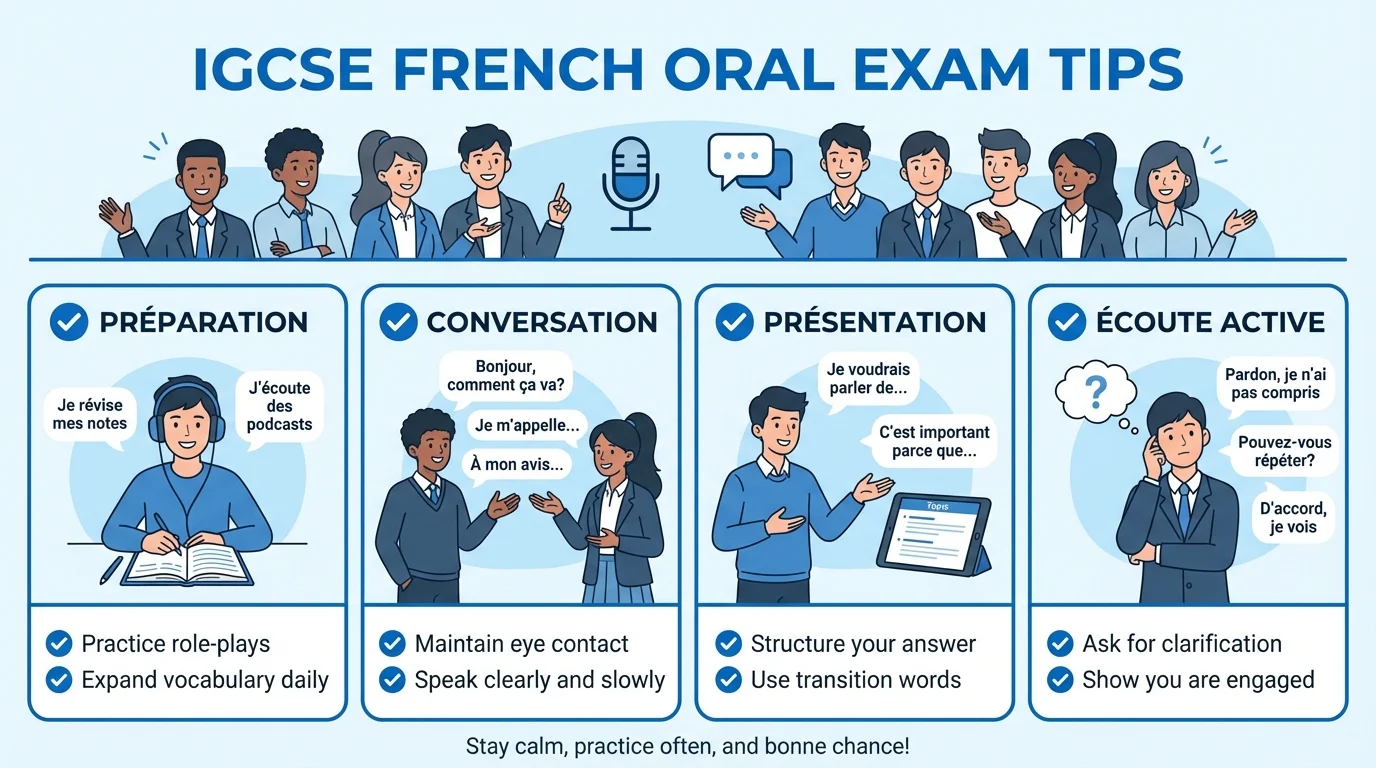
How to Answer IGCSE French Oral Exam Questions

How to Answer an IGCSE French Oral Exam Question

(With Tips and Examples) — The examiner isn’t expecting perfection. They want to hear how confidently you speak and communicate your ideas.

IGCSE French Oral Exam Tips - Complete Guide with Examples
IGCSE Level: A2-B1

🗣️ Communication Over Perfection

The IGCSE French oral exam is designed to test how well you can communicate in spoken French. The examiner is not expecting perfect grammar or advanced vocabulary.

Instead, they want to hear:

  • How confidently you speak
  • How well you develop your answers
  • How effectively you express ideas and opinions on familiar topics

📚 What Will the Questions Be About?

In the IGCSE French oral exam, all questions are based on everyday topics that are familiar to you. You are never asked about abstract or specialist subjects. Typical topics include:

  • 👨‍👩‍👧‍👦 Family and friends
  • ⚽ Free time and hobbies
  • 🥐 Food and daily routines
  • 🏠 Home and town
  • ✈️ Holidays and travel
  • 🏫 School life
  • 💼 Future plans and jobs
  • 📱 Social media and technology

1️⃣ Understand the Question First

Listen Carefully & Identify Key Elements

Before answering, take a moment to understand the question. Listen carefully and identify:

  • The topic
  • The key verb (e.g., aimer, faire, préférer, penser…)
  • The time frame (past, present, or future)

💡 Pro Tip: If you are unsure, you are allowed to ask the examiner to repeat the question:

« Pardon, pouvez-vous répéter, s’il vous plaît ? »

This is completely acceptable and does not reduce your marks. It is better to clarify than to answer incorrectly.

2️⃣ Do Not Answer Only “Yes” or “No”

🚫 Common Mistake: Stopping after one sentence.

One of the most common mistakes in the oral exam is stopping after a short answer such as oui or non.

Always ask yourself: “Can I add another detail?”

The examiner wants to hear how you manage spoken French: how you link ideas, give explanations, and keep talking.

✅ 6 Elements to Make Your Answer Complete

Use this mental checklist every time you answer a question:

1. Give Reasons (Why?)

Explain your opinion or choice.

“J’aime l’école parce que j’apprends des choses utiles pour l’avenir.”

(I like school because I learn useful things for the future.)

2. Add Details

Include information about time, place, frequency, or people.

“J’y vais du lundi au vendredi et je travaille surtout le matin.”

(I go there from Monday to Friday and I mainly work in the morning.)

3. Give Examples

Examples make your answer clearer and more natural.

Par exemple, j’aime le français et l’histoire.”

(For example, I like French and history.)

4. Express Opinions and Justifications

Show personal thinking using opinion phrases.

À mon avis, l’école est importante parce qu’elle prépare les jeunes au monde du travail.”

(In my opinion, school is important because it prepares young people for work.)

5. Use More Than One Tense (If Possible)

Using different tenses shows a stronger level of French.

“L’année dernière, j’ai changé d’école et à l’avenir je voudrais aller à l’université.”

(Last year, I changed schools and in the future I would like to go to university.)

6. Add One Extra Comment or Contrast

A small contrast makes your answer sound more advanced.

Cependant, je trouve que les devoirs sont parfois stressants.”

(However, I find homework sometimes stressful.)

🌟 Example of a Complete Answer

Question: Aimes-tu les réseaux sociaux ?

“Oui, j’aime beaucoup les réseaux sociaux parce que je peux rester en contact avec mes amis. J’utilise surtout Instagram et WhatsApp tous les jours. Par exemple, j’envoie des messages et je regarde des photos. À mon avis, c’est très pratique pour communiquer, mais parfois c’est une perte de temps. À l’avenir, j’essaierai de passer moins de temps sur mon téléphone.”

Why is this answer great? It includes opinions, reasons, details, examples, different tenses (present & future), and a contrast — exactly what examiners are looking for! 🏆

🧘 Last Minute Advice: Stay Calm

It is better to pause briefly and give a clear, developed answer than to rush and panic.

  • Small mistakes are normal. don’t worry!
  • Take your time to think.
  • What matters most is that you keep speaking and communicate your ideas clearly.

Ready to Ace Your IGCSE French Oral Exam?

Get expert preparation with our native teachers. We focus on confidence, fluency, and exam techniques.

✅ IGCSE-focused workshops  |  ✅ Mock oral exams  |  ✅ Native French teachers

DELF vs TCF: Which French Exam Should You Choose?

DELF vs TCF: Which French Exam Should You Choose?

Diploma vs Test? Lifetime validity or quick results? A complete guide to understanding the differences between DELF and TCF to help you make the right choice for your goals.

DELF vs TCF Comparison

When learning French as a foreign language, many learners eventually need to take an official exam to prove their level. Two of the most common French language certifications are the DELF and the TCF. Although both are internationally recognized and issued by the French Ministry of Education, they serve different purposes and follow very different formats.

Understanding the difference between the DELF and the TCF will definitely help you make the right decision and pick the exam that best suits your goals.

🎓 The Main Difference: Diploma vs Test

DELF (Diplôme d’Études en Langue Française)

🏆 Valid for LIFE

The DELF is a diploma. This means that once you pass it, the certification is valid forever. You receive an official diploma certifying that you have achieved a specific level of French.

  • Permanent certification
  • Like a university degree
  • Pass or Fail system

TCF (Test de Connaissance du Français)

⏱️ Valid for 2 Years

The TCF is a language proficiency test. It evaluates your level at a given moment, giving a “snapshot” of your skills. The results are valid for only two years.

  • Temporary certification
  • Like IELTS or TOEFL
  • No fail – you get a score

📊 Levels and Structure

DELF Structure: Independent Levels

The DELF is divided into separate diplomas. Each corresponds to a certain level of the CEFR (Common European Framework of Reference for Languages).

A1 A2 B1 B2

How it works: Candidates must choose one level in advance and pass all parts of that level to obtain the diploma. You either pass or fail; there is no partial result.

TCF Structure: Multi-Level Test

The TCF works differently. It is a level-placement test that assesses your French skills and places you on the CEFR scale.

A1 A2 B1 B2 C1 C2

How it works: Unlike the DELF, the TCF evaluates all levels of the CEFR in a single exam. You do not get to choose a level beforehand; your score determines it for you.

📝 Exam Format & Skills Tested

Both exams assess the four main language skills: listening, reading, writing, and speaking, but the format differs significantly.

👂 Listening

DELF: Uses level-specific real-life tasks, such as understanding announcements, conversations, or short interviews.

Focus: Comprehension in context


TCF: Relies on standardized multiple-choice questions (MCQ).

Focus: Quick analysis & key info

📖 Reading

DELF: Includes practical texts like emails, articles, or instructions requiring written answers.

Focus: Detailed understanding


TCF: Uses multiple-choice texts to measure overall comprehension quickly.

Focus: Speed & accuracy

✍️ Writing

DELF: Requires level-specific written tasks (messages, letters, essays, reports).

Focus: Expression & structure


TCF: Tests general proficiency. Can be optional depending on the version (e.g., compulsory for TCF Canada).

Focus: General ability

🗣️ Speaking

DELF: Involves face-to-face interaction with examiners, including role-plays and monologues suited to the level.

Focus: Interaction & fluency


TCF: Shorter and more structured interview. Can also be optional.

Focus: Spontaneous responses

⚡ Quick Comparison Table

Feature DELF (Diploma) TCF (Test)
Validity Lifetime ♾️ 2 Years
Type Pass/Fail Diploma Placement Test (Score)
Levels Choose 1 Level (A1-B2) All Levels (A1-C2)
Format Real-life tasks Multiple Choice (mostly)
Purpose Personal/Professional Achievement Immigration/Visa/University
Result Time ~10 weeks ~4 weeks

🎯 Purpose and Target Audience

Choose DELF if…

  • You want a long-term certification valid for life.
  • You are a student, professional, or language enthusiast.
  • You want to officially validate a specific level (e.g., B2).
  • You are building a CV for long-term career goals.
  • You prefer real-life tasks over multiple-choice questions.

Choose TCF if…

  • You need quick results for a specific procedure.
  • You are applying for immigration (e.g., Canada).
  • You need proof of level for university enrollment now.
  • You want a “snapshot” of your current level on the A1-C2 scale.
  • You are comfortable with multiple-choice test formats.

🚀 Final Verdict: Which One Should You Choose?

Overall, while both exams assess French proficiency, choosing between DELF and TCF depends entirely on your objective.

➡️ If you want a permanent diploma that certifies a clearly defined level for life, the DELF is usually the better option.

➡️ But if you need quick, up-to-date proof of your French level for a specific administrative procedure (like a visa or university application) and at a given moment, then the TCF may be more appropriate.

Ready to Prepare for Your Exam?

Whether you choose DELF or TCF, Interactive French has the expert courses to help you succeed. Join 5,000+ students achieving their goals!

Which French Exam Should I Take in Hong Kong? 2026 Complete Guide & Dates

📚 French Exams in Hong Kong 2026

All French exams available in Hong Kong with dates, fees and official registration links. Click on each exam to see complete details.

⚡ Registration Now Open

DELF/DALF March and April 2026 sessions are now open for registration. Limited seats available!

🏆 DELF A1, A2, B1 A1 A2 B1
Official lifetime diploma • Beginner to intermediate levels • March 2026 session
📅 Dates
March 3-6, 2026
📝 Registration
January 2 – February 2, 2026
💰 Fees
A1: HK$1,500 • A2: HK$1,700 • B1: HK$2,100
📍 Location
Alliance Française Hong Kong
⏱️ Results
~10 weeks
✅ Validity
Lifetime diploma (never expires)

📆 Detailed March 2026 Schedule

A1 March 3-4 • Written: March 3, 09:00-10:20
A2 March 4-5 • Written: March 4, 09:00-10:40
B1 March 5-6 • Written: March 5, 09:00-10:55
🎓 DELF B2 & DALF C1, C2 B2 C1 C2
Official lifetime diploma • Advanced levels • April 2026 session
📅 Dates
April 20-29, 2026
📝 Registration
February 13 – March 18, 2026
💰 Fees
B2: HK$2,300 • C1: HK$3,100 • C2: HK$3,300
📍 Location
Alliance Française Hong Kong
⏱️ Results
~10 weeks
✅ Validity
Lifetime diploma

📆 Detailed April 2026 Schedule

B2 April 20-21 • Written: April 21, 09:00-11:30
C1 April 22-23 • Written: April 23, 09:00-13:00
C2 April 27-29 • Written: April 27, 09:00-12:30
👦 DELF Junior (Ages 11-17) A2-B2
Lifetime diploma for secondary students • Required for HKDSE • November 2026 session
📅 Dates
November 3-18, 2026
📝 Registration
September 2 – October 3, 2026
💰 Fees
A2: ~HK$1,700 • B1: ~HK$2,100 • B2: ~HK$2,300
👥 Age
11-17 years (secondary school)
🎯 Purpose
Required for HKDSE (must be taken 2 years before HKDSE exam)
⚠️ Important for HKDSE 2027: DELF Junior A2 or higher must be taken by November 2026 at the latest (2 years before HKDSE 2027 exam).
📋 TCF Tout Public Multi-level A1-C2
Certificate valid 2 years • Fast results • 7 sessions in 2026
💰 Fee
HK$1,800 (compulsory tests) + optional tests
⏱️ Results
~4 weeks (electronic certificate)
✅ Validity
2 years
📍 Locations
Alliance Française Jordan Centre & Hong Kong Scout Centre

📆 TCF Tout Public 2026 Sessions

February 6 Registration: Dec 6, 2025 – Jan 6, 2026
September 8 Registration: July 8 – August 8, 2026
November 24 Registration: Sept 24 – Oct 24, 2026
🍁 TCF Canada B2 minimum required
Special immigration exam • 4 compulsory tests • 3 sessions in 2026
💰 Fee
HK$3,500
📝 Format
4 compulsory tests: listening, reading, speaking, writing
🎯 Required Level
B2 minimum for immigration
📍 Location
Hong Kong Scout Centre
⏱️ Schedule
Written: 09:00-11:45 • Oral: 12:30-16:00

📆 TCF Canada 2026 Sessions

January 20 Registration: Nov 17 – Dec 17, 2025
June 2 Registration: April 1 – May 1, 2026
October 20 Registration: Aug 20 – Sept 20, 2026
📚 IGCSE French A2-B1
Cambridge 0520 & Edexcel 4FR0 • Ages 14-16 • May 2026 session
📅 Speaking Dates
March – April 2026
📅 Written Dates
May 18-22, 2026
👥 Age
14-16 years (secondary school)
📝 Registration
Via your school or HKEAA
🎯 Target Level
A2-B1 (CEFR)

📆 Cambridge 0520 – Detailed Dates

Speaking March 1 – April 30, 2026
Listening May 18, 2026 (Monday)
Reading May 21, 2026 (Thursday)
Writing May 22, 2026 (Friday)
🌍 IB French B1-C1
Language A, B & ab initio • Ages 16-18 • April-May 2026 session
📅 Dates
April 24 – May 19, 2026
👥 Age
16-18 years (IB Diploma students)
📝 Registration
Via IB schools
📚 Courses
• Language A (native/bilingual speakers)
• Language B (advanced learners)
• ab initio (beginners)

📆 IB French 2026 Sample Dates

French A – Paper 1 May 1, 2026, 14:00
French A – Paper 2 May 5, 2026, 14:00
French B – Paper 1 April 29, 2026, 14:00
French B – Paper 2 May 7, 2026, 08:30
Oral (all courses) April 24 – May 20, 2026
🎓 A-Level French B2-C1
Cambridge International • Ages 16-18 • May-June 2026 session
📅 Speaking Dates
April 2026
📅 Written Dates
May/June 2026
👥 Age
16-18 years
🎯 Level
B2-C1 (CEFR)
📝 Registration
Via your school or HKEAA

Need Help Choosing?

Over 5,000 students have successfully passed their French exams with Interactive French. DELF pass rate: 100%.

What is Oxford AQA IGCSE French?

🎓 What is Oxford AQA IGCSE French?

Looking for a French qualification that opens doors academically and internationally? OxfordAQA International GCSE French is a globally recognised exam designed for students who want more than just basic conversational French. It’s a credential that shows schools, universities, and future employers that you can use French seriously and confidently.

Whether you’re studying at an international school, at home, or planning to continue your studies abroad, this exam can be an important step in your academic journey.

👥 Who is it for?

OxfordAQA IGCSE French is perfect for:

  • Students at international schools or private learners who want a qualification recognised worldwide.
  • Learners who want to build a strong foundation in French for further study, such as A-level French, the IB Diploma, or other advanced programs.
  • Anyone serious about improving their French for academic, personal, or professional purposes.

In short, it’s for learners who see French as more than just a subject — it’s a skill that can open doors for future studies and opportunities.

🎯 Why take OxfordAQA IGCSE French?

✅ Key Advantages

  • Globally recognised: Accepted by schools and universities around the world.
  • Academic value: Passing this exam demonstrates real language competence for A-levels, IB programs, and university courses.
  • Relevant and flexible content: Topics include identity, culture, global issues, and education.

⚖️ How it differs from standard GCSE French

  • International audience: The syllabus is designed for global students, not just UK learners.
  • Focus on final assessments: More emphasis on exams than coursework, ideal for private study.
  • Global contexts: Themes reflect real-life international scenarios rather than UK-specific examples.

📚 What is the IGCSE French syllabus made of?

The OxfordAQA IGCSE French syllabus covers topics that are both practical and academically relevant:

🇫🇷 Key Syllabus Themes

The main topics include:
Identity and culture
Local and global issues
Education
Future plans
Current affairs

These themes provide the vocabulary, grammar, and communication skills you need not just to pass the exam, but to continue learning French at higher levels.

✏️ What to expect during the exam

The exam is designed to test your command of the language across four distinct papers. Unlike some qualifications where written work dominates, OxfordAQA places equal importance on all key skills: Listening, Speaking, Reading, and Writing. Each skill is weighted equally at 25%, ensuring a balanced assessment of your fluency.

📋 Exam Structure Overview

Paper Duration Skills Assessed Weighting
Listening ~50 min Understanding spoken French 25%
Speaking ~20 min Oral expression and interaction 25%
Reading ~1h15 Reading comprehension 25%
Writing ~1h15 Essays, structured responses, translations 25%

The structure ensures that you are tested on real communication skills, preparing you for more advanced academic work in French.

🎓 How to prepare for Oxford AQA IGCSE French?

💡 Effective Preparation Strategies

  • Work through the syllabus themes: Focus on identity, culture, global issues, and education to cover everything the exam may ask.
  • Practice past papers: Familiarity with the exam format builds confidence.
  • Develop all skills equally: Listening, reading, writing, and speaking all need attention — the exam tests them equally.
  • Focus on communication: Being able to express yourself clearly matters as much as grammatical accuracy.
  • Review grammar and vocabulary systematically: Make sure you can use essential tenses and topic-related words with confidence.

For students seeking structured guidance, extra practice, and feedback tailored to the OxfordAQA IGCSE French, contact us at Interactive French. As native French tutors in Hong Kong, we offer specialized courses designed to prepare learners effectively — helping them succeed academically and open doors to further study.

Alors, prêt à relever le défi? Your IGCSE French journey starts here!

What is HKDSE about in 2026?


Key information

  • What Skills are Tested? 
    The exam tests Listening, Reading, Writing, and Speaking, each worth 25% of the total mark.
  • What Exam? 
    The HKDSE French exam uses the internationally recognized DELF A2 (Diplôme d’Études en Langue Française).
  • What is Required? 
    You must achieve DELF A2 or higher to get an HKDSE Category C result.

Two for One: You get two official certificates—the DELF certificate and the HKDSE result—from one exam.


🇫🇷 Your French Success in Hong Kong: The HKDSE French Exam (DELF A2)

The French language is a gateway to international opportunities, and for students in Hong Kong, the HKDSE Category C (Other Languages) subject for French now offers an even smoother path to official certification. Since 2025, the French certification is based on the globally recognized DELF A2 (or higher levels), marking a significant and beneficial change for students.

📝 HKDSE French Exam Structure (DELF A2)

The HKDSE French examination utilizes the internationally recognized DELF A2 (Diplôme d’Études en Langue Française), which assesses all four core language skills. This format provides students with “one exam, two certificates”—the official French government diploma and an HKDSE Category C result.

To make this information easily digestible and mobile-friendly, here is the structure in a bulleted format:

  • Listening (Compréhension de l’oral)
    • Focus: Understanding short, simple recordings about everyday life.
    • Duration: Approximately 35 minutes
    • Weighting: 25% of the total mark
  • Reading (Compréhension des écrits)
    • Focus: Understanding short, simple written texts on familiar topics.
    • Duration: Approximately 45 minutes
    • Weighting: 25% of the total mark
  • Writing (Production écrite)
    • Focus: Producing two short, simple written texts (e.g., a letter, message, or description) on everyday situations.
    • Duration: Approximately 45 minutes
    • Weighting: 25% of the total mark
  • Speaking (Production orale)
    • Focus: A three-part test involving a guided conversation, exchanging information, and a short monologue/role-play.
    • Duration: 6–8 minutes preparation + 10 minutes exam
    • Weighting: 25% of the total mark

Passing Requirement: To successfully pass the DELF A2, you need an overall score of at least 50/100, with a minimum of 5/25 in each of the four components.


✅ The DELF Advantage: A Flexible Path to Certification

The shift from the previous Cambridge International Advanced Subsidiary (AS) level examination to the DELF A2standard for HKDSE French is a major benefit for Hong Kong students. This change offers significant advantages in terms of accessibility, flexibility, and global recognition:

  • Lower Entry Level, Easier to Achieve: The previous AS-level was significantly more demanding. The DELF A2 is an Elementary User level (CEFR A2), which requires a far more manageable time investment (estimated 270 learning hours) for students to achieve a Category C result.
  • Multiple Attempts & Best Score Reporting: Unlike many single, high-stakes exams, the DELF exam can be taken multiple times within the two years preceding the HKDSE you sit. The HKEAA will only report the highest language proficiency level and result attained on your HKDSE certificate. This retake flexibility significantly reduces pressure and provides a powerful safety net for students.
  • Internationally Recognized and Valid for Life: The DELF/DALF are official diplomas issued by the French Ministry of Education. Achieving this certification provides a lifelong, internationally recognized proof of French proficiency, useful for academic applications (especially in French universities) and career prospects worldwide.

This modern structure makes French a more attractive and strategic elective choice, providing HK students with a highly valuable, dual certification that is both simpler to achieve and much more flexible to manage during their demanding secondary school years.


🌍 The Cultural & Life Topics

The syllabus aims for practical, real-world communication. The French you learn will cover a diverse range of topics, ensuring you can navigate life in a Francophone environment and appreciate the rich French culture.

Key thematic areas for the exam include:

  • Daily Life & People: Family, young people, patterns of daily life, food, and drink.
  • Health & Wellness: Health and fitness.
  • Work & Leisure: Work, leisure, and sport.
  • The Global Community: Travel and tourism, cultural life, social and economic development, and the environment.

✨ Why Choose French? The Interactive French Advantage

Learning French with a French tutor is more than just passing an exam; it’s a profound investment in your future.

  1. Academic & Career Boost: French is a working and official language of international organizations like the UN and the EU. Achieving a B2 level or higher is often required for direct university entry in France! Your French skills give you a competitive edge in sectors like luxury goods, diplomacy, tourism, and business.
  2. Cultural Immersion: Learn the language of fashion, gastronomy, art, cinema, and philosophy. By mastering French, you gain direct access to an incomparable cultural universe and can experience travel more authentically.
  3. Brain Power: Studies show that learning a new language like French enhances cognitive skills, including memory, concentration, and problem-solving abilities. Plus, as a Romance language, it acts as a stepping stone to easily learning Spanish, Italian, and Portuguese!

At Interactive French, our expert native French tutor team specializes in personalized preparation for the DELF A2 and higher levels. We provide structured lessons, targeted exam strategies, and an engaging, interactive environment to help you not just pass, but excel and embrace the full richness of the language.

Ready to start your journey to fluency and secure a top result in your HKDSE French exam?

What is the AP French Exam?

Are you passionate about the French language and aiming for academic excellence?
The AP French Language and Culture exam is a rigorous test designed to certify students have achieved a level of proficiency equivalent to a third-year college French course.

🎓 AP French Language and Culture: A Quick Introduction

The AP French Language and Culture course and exam, offered in high schools, is an opportunity to earn college credit and/or placement. It’s a comprehensive, college-level experience designed to develop your fluency and deep understanding of the French-speaking world’s culture in contemporary and historical contexts.


The Six Core Themes (Course Content)

The entire course curriculum and all exam materials—from articles to audio clips—are organized around six major, overarching themes that connect French language and culture globally. Understanding these themes is crucial for success and is a key area where a dedicated French tutor can provide targeted support.

  1. Families and Communities (La famille et la communauté): Exploring social institutions, family structures, customs, and community values across Francophone societies.
  2. Personal and Public Identities (La Quête de soi): Examining the formation of identity, alienation, self-expression, and multiculturalism.
  3. Beauty and Aesthetics (L’esthétique): Investigating the concepts of beauty, artistic expression (art, architecture, fashion), and their impact on daily life.
  4. Science and Technology (La science et la technologie): Discussing innovation, scientific discovery, ethical questions, and the impact of technology on society.
  5. Contemporary Life (La vie contemporaine): Analyzing daily life, education, work, leisure, travel, and social issues in the French-speaking world.
  6. Global Challenges (Les défis mondiaux): Addressing complex issues like environmentalism, political systems, human rights, and economic concerns.

Detailed Exam Format and Skills Tested

The three-hour exam is divided into two equally weighted sections, testing the three modes of communication (Interpretive, Interpersonal, and Presentational):

Key Free-Response Details:

SectionTasksTime durationExam Weight
I: Multiple Choice
(65 questions)
Part A: Print Texts 
(30 questions)
40 minutes23%
Part B: Print & Audio Texts 
(35 questions,
played twice)
55 minutes27%
II: Free Response
(4 Tasks)
Written Task 1: Email Reply
Interpersonal Writing
15 minutes12.5%
Written Task 2: Argumentative Essay
Presentational Writing
55 minutes12.5%
Spoken Task 1: Simulated Conversation
Interpersonal Speaking
18 minutes total 12.5%
Spoken Task 2: Cultural Comparison
Presentational Speaking
12.5%
  • Argumentative Essay: This task requires true college-level analysis. You must synthesize information from three authentic sources (a print article, a chart/graphic, and an audio clip) to build a clear, well-supported, and persuasive argument.
  • Cultural Comparison: This is a 2-minute oral presentation where you must compare a cultural aspect of a Francophone community (e.g., attitudes towards work, importance of family) to your own community, citing specific examples.

📈 Latest Evolution and Future Changes

The AP French exam underwent a major redesign in 2012, shifting its focus entirely to a proficiency-based model centered on communication and culture, moving away from purely grammar-based questions.

The most recent and significant evolution planned is the shift towards a digital exam format and standardized course frameworks for all AP World Languages, set to launch in the 2026-2027 school year (at the earliest):

  • Digital Format: The exam will transition to the Bluebook digital testing application, discontinuing the paper format.
  • Streamlined Structure: The question types will be reorganized and standardized across AP World Languages.
  • Course Project: A new, required course project will be introduced where students use authentic sources to prepare for speaking tasks that will be completed on exam day, further emphasizing authentic communication.

These changes aim to modernize the testing experience and align the exam even closer with true, real-world language use and contemporary college-level expectations.

Why Learn French in Hong Kong: Career, Immigration & Exam Benefits

🇭🇰 Your Edge in Asia & Beyond 🇫🇷: Why Learn French in 2026?

The French language is not just a cultural pursuit; it’s a strategic professional asset for Hong Kong students and professionals aiming for global mobility and a competitive edge in Asia. As a key international language, French offers unique pathways in finance, luxury, education, and immigration that resonate specifically with the ambitions of HK learners.

At Interactive French, your trusted language center, we understand the value of an efficient and targeted learning path. Let us help you gain fluency and achieve your goals with our dedicated native French tutor support.


💼 Career Advantage: French in Hong Kong’s Key Sectors

For learners in Hong Kong, French proficiency translates directly into high-value opportunities in sectors crucial to the city’s economy.

🇫🇷 Professional French Benefits for Hong Kong 🇭🇰

  • Luxury Goods and Retail: Hong Kong is a global hub for luxury fashion, jewellery, and high-end goods. Many major French luxury brands (LVMH, Chanel, Hermès, etc.) have regional headquarters or significant operations here. Speaking French is a distinct advantage for roles in management, marketing, sales, and purchasing.
  • International Finance and Business: France has the world’s fifth-largest economy and is a major player in European finance. French is a working language at major international organizations. Adding French to your CV opens doors to multinational corporations operating between Europe and Asia, enhancing your career prospects in banking and global trade.
  • Canada & Global Migration: For those considering immigration or work visas in Canada (especially Quebec), French proficiency is often the single most significant factor for eligibility and scoring points under various programs. Learning French now is a direct investment in your long-term mobility.

🎓 Academic Pathways: Europe’s Best Education

Gain access to world-renowned European universities and institutions, often at a lower cost than comparable English-speaking countries.

📚 Educational Opportunities with French

  • Elite University Entry: A strong French level, usually certified by the DALF C1/C2, is required for admission to prestigious Grandes Écoles and specialized programs in business, engineering, and arts in France. This education is highly valued by employers worldwide.
  • Student Mobility: Proficiency in French makes living, studying, and completing an internship in Europe far smoother, enriching your academic exchange and networking opportunities. Our native French tutor team offers specialized training to ensure you meet university language entrance requirements.

💯 Exam Focus: DELF, DALF, and TCF for HK Learners

Certification is essential for university applications, job applications in multinational firms, and immigration. We prepare you comprehensively for the official French exams.

🏆 French Certification Options

Exam Levels Key Benefit for HK Learners Validity
DELF (A1–B2) Beginner to Intermediate Official proof of general French for work or study. Lifetime
DALF (C1–C2) Advanced Mastery Required for entry into most French universities; excellent for professional credentials. Lifetime
TCF (A1–C2) All Levels (Score) Often used for Canadian immigration (TCF Canada) and quick assessment of language skills. 2 Years

We run intensive workshops and one-on-one sessions focused on the exam formats to help you achieve your desired score in 2026.


🌍 Culture & Connection: Beyond the Classroom

Learning French allows you to move beyond tourism and truly connect with a global culture that influences art, cuisine, and design.

🗣️ Cultural & Social Benefits

  • Connect with Francophones: In a diverse city like Hong Kong, knowing French allows you to network and communicate with the local community of French expatriates and visitors.
  • Cultural Fluency: Appreciate French literature, film, and philosophy in their original form. This cultural fluency is a sophisticated asset in any international setting.

Don’t wait to secure your global advantage in 2026!

Would you like to register for a placement test to determine your current French level and recommend a study plan focused on your career or academic goals? Ready to unlock these career benefits? Our French lessons for adults offer 11 CEFR levels from complete beginners to advanced B2+.

What is TCF French? Exam Guide: Format, Scoring & Preparation Tips

The TCF (Test de Connaissance du Français) is an official French language proficiency exam recognized worldwide. Whether you need proof of your French level for immigration, university admission, or professional purposes, the TCF is a flexible test designed for non-native speakers of French.

Valid for two years, the TCF assesses your ability to understand and use French in everyday, academic, and professional contexts.

Key Information

  • Official French exam recognized worldwide, valid for 2 years
  • Required for immigration, universities, and professional certification
  • Several versions: TCF Tout Public, TCF Canada, TCF Québec, TCF DAP
  • Tests listening, reading, grammar, writing, and speaking
  • Results mapped to CEFR levels (A1 → C2)
  • Preparation with mock tests and guided lessons boosts success

Why Take the TCF?

  • Immigration → Required for certain visas and residency applications (for example, TCF Canada or TCF Québec).
  • Higher Education → Many French universities and Grandes Écoles require a valid TCF score.
  • Professional Use → Employers and institutions often ask for proof of French language proficiency.

👉 In short: if you need an official French exam in 2025, the TCF is one of the most recognized options available and widely accepted by French-speaking institutions.

Different Types of TCF

  • TCF Tout Public (General TCF)
    • Open to anyone, regardless of background.
    • Useful for personal, academic, or professional certification.
  • TCF Canada
    • Specifically designed for Canadian immigration procedures.
    • Assesses listening, speaking, reading, and writing.
  • Other Versions
    • TCF Québec → for immigration to Québec.
    • TCF DAP → required for first-year university applications in France.

Test Format and Structure

The TCF consists of compulsory and optional sections:

  • Compulsory Tests (Multiple-choice questions):
    • Listening Comprehension
    • Reading Comprehension
    • Grammar & Vocabulary
  • Optional Tests (depending on your needs):
    • Written Expression
    • Oral Expression

⏱️ Duration: Between 1h30 and 2h45, depending on the chosen modules.

How Is the TCF Scored?

Your performance is measured on a scale corresponding to the CEFR levels (A1 → C2). Your official TCF certificate will indicate your level for each skill tested.

  • A1 = Beginner
  • B1 = Independent User
  • C1/C2 = Advanced Proficiency

Each section is scored separately, and your results are placed on the CEFR scale. Unlike the DELF/DALF where you pass or fail a level, the TCF gives you a certificate showing your precise level in each skill. This flexibility is why many institutions prefer the TCF: it reflects your current abilities rather than a fixed level.

Happy woman jumping for joy after passing her TCF French exam

Our student celebrates her TCF French certification – join our exam preparation courses today!

How to Prepare for the TCF

  • 3 months before the exam → Familiarize yourself with the format using official TCF sample tests.
  • 6 weeks before the exam → Focus on weak areas (grammar drills, vocabulary building, essay practice).
  • 2-3 weeks before → Simulate the exam under timed conditions.
  • Ongoing → Improve your French every day: listen to podcasts, watch TV shows, read short articles, and practice speaking regularly.

👉 A combination of independent practice and guided preparation with a native French teacher gives you the best chance of success.

Prepare for the TCF with Interactive French

At Interactive French, we specialize in helping students succeed on the TCF through:

  • Personalized preparation courses (online or in-person in Hong Kong)
  • Mock exams under real conditions
  • Targeted training for TCF Canada and TCF Tout Public
  • Practical feedback to improve speaking and writing from a native French tutor

Our goal is simple: to help you achieve the TCF score you need with confidence.

Discover our TCF Prep Courses